

Viking Line introduces a green corridor, reducing emissions by 90%
Viking Line’s vessels serving the Turku route will reduce their emissions by 90 per cent when the company runs those vessels for the first time for a whole week solely on biogas.
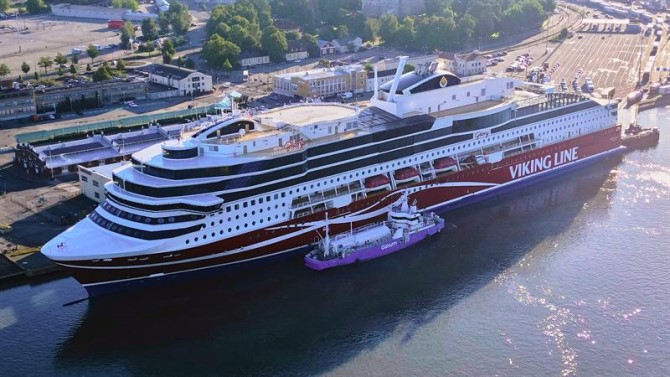
Source: Viking Line
During the week, which kicks off with Baltic Sea Day, Viking Glory and Viking Grace will demonstrate what the future looks like for the first green shipping corridor on the Baltic Sea.
Viking Line will celebrate Baltic Sea Day by introducing the first green corridor ever on the Baltic Sea, between Turku and Stockholm, for one week. The climate-smart Viking Glory and Viking Grace will only use liquefied biogas (LBG) as a fuel from August 29 to September 4, which will reduce the vessels’ carbon dioxide emissions by 90 per cent compared to liquefied natural gas (LNG), which is normally used.
During the week, a total of about 2,600 fewer tonnes of greenhouse gas emissions will be generated than normally. The reduction corresponds to the annual average carbon dioxide footprint for 270 Finns.
According to Dani Lindberg, head of sustainability at Viking Line, the launch of regular marine services powered solely by biofuel is a historic moment for the company, the Baltic Sea and shipping. He emphasized that Viking Line has invested 450 million euros in the Viking Grace and Viking Glory vessels, which can be powered by LNG, biofuel and future synthetic fuels from renewable energy. Lindberg noted that these measures are the result of long-term environmental work.
For one year now, Viking Line has offered its passengers and its conference and cargo customers the option of purchasing biofuel corresponding to the amount of fuel used for their travel. This reduces emissions by 90 per cent per passenger or cargo unit.
Dani Lindberg added that both consumers and corporate customers expect responsible actions and are ready to support the conservation of the Baltic Sea. He pointed out that the number of cruises using biofuel increased by 500% after the introduction of this option in the booking system.
Normally, liquefied natural gas (LNG) is used on the Turku route, and this fuel has significantly lower nitrogen oxide emissions than the heavy fuel oil traditionally used on vessels. Both LNG and LBG (liquefied biogas) generate virtually no harmful sulfur or particle emissions.
Viking Line’s biogas is supplied by Gasum, which makes the fuel from food and agricultural waste. The biogas is produced in Europe, and the origin of each gas consignment is clearly documented.
Dani Lindberg says Viking Grace has already been operated using biogas on the Turku route, and passengers and cargo customers can buy biogas at the time of booking, reducing emissions by up to 90%. Now, for the first time, the company is operating all week exclusively on biogas, which is unique. He pointed out that the availability of renewable fuels is limited, and they are at least twice as expensive as LNG, so creating demand to increase supply and lower the price is key.
Viking Line is involved in efforts to develop a green sea corridor between Turku and Stockholm and between Helsinki and Tallinn. These green corridors are routes where the transport of both cargo and passengers is carbon-neutral. Emission reductions in maritime transport are regulated in part by the EU’s Fit for 55 programme for a green transition and the EU emissions trading system as well as the International Maritime Organization’s strategy for greenhouse gas emissions.
Source:
[Viking Line]